What about the dimple?
You may actually be saying, what dimple? You'll find an arrow at the left of frame which is at what is purported to be
the supposed impact location. Below it and straddling the picture's edge is a perfectly circular feature
who's rim has what looks to be circular features perched on the rim. These may be rim-craters which are seen
on many celestial bodies. They defy convention explanations of a physical impact but they occur
often with the features made by electrical discharges.
This question will be answered in greater detail once i get a reply about other
electrical discharge
characteristics which, from experiments, cause craters. For the moment i'm trying to get a better image
which shows the dimple which has a rim-crater, maybe two. These are important features that also point
to electrical processes. The formation of a Lichtenberg feature involves current flowing out, yet
the occurrance of a return stroke is not too far fetched, it happens in other situations.
Flat-floored craters associated with cathode arcing are also common.
| Imaged below is the Tunguska Event region. A Bolt from below suggests a discharging body, the earth. (arrow points to purported impact.) (Flash Earth) 
| 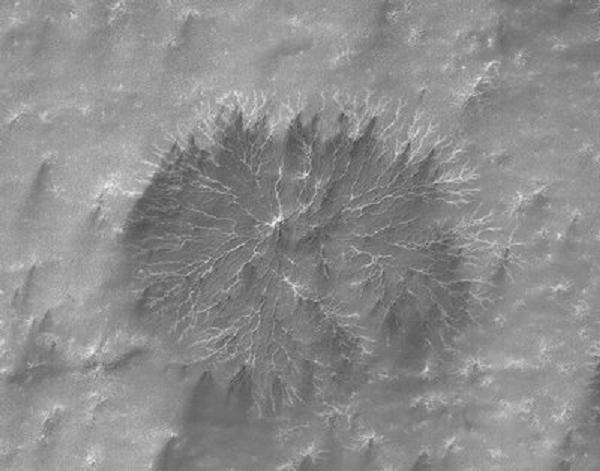 |
Unmistakable similarities to note are the tendrils which extend from a focal point which is the exit point of the charged bodies discharge. The image above on the right is from Mars. Many similar patterns point to the Mars feature being a burst of electrical energy at macro proportion. The tunguska event is likely a close cousine.
 |
The image at left and below are both from electric discharges between the screens of two old CRTs.  |
All of these features are forms of lichtenberg figures. The paths taken by the discharging electrons seems to leave
a residual polarity signiture on the surface which attracts material.
During the Acrylic block, Captured Lightening discharges, the paths are an internal characteristic.