Be sure to read about the discovery of many of these elsewhere and the mystery surrounding them. My comments at the bottom of this page.
Presently,2011, one ?spike was found. The layer of glassified sand appears to be localized..
A 2014 well encountered only sand at the level of the first find and the second location wasn't thoroughly examined, for confirmation of what appeared to be glassified material. Localized electrical discharges might be expected of this former agricultual facility. Wells and lightning rods may have provided a path to the sand layer and stored water.
The sand spikes from the 2006 drilling may be a concretion and not electric formed unless of course concretion formation were to have an electrical component.
Have a look at
many of the images here.
And be sure to go to earlier experiments involving passing electric current through a saltwater/sand solution. This formed concretion-looking samples.
Some new images have been added to the index /electric-geology
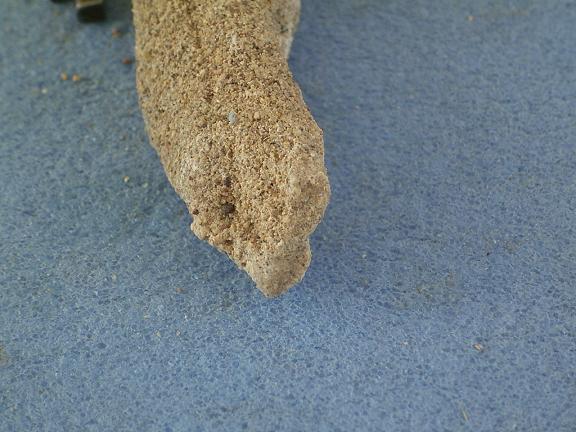
These are bofore&after shots of a muriatic acid dipping of just the tips.
I'll have to take some other shots with more attention to orientation and at 1280resolution.
One of the old shots |
This is one of the new shots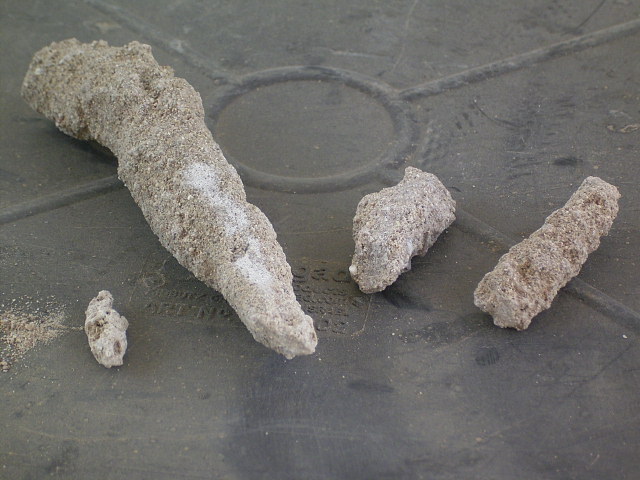 |
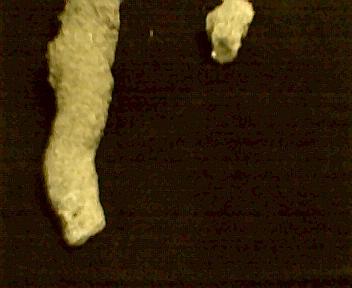
The old image is from my cheepo first digital camera bought for this find. I have much better images being added having now a better camera and 3D capability..(will get to the 3D later)
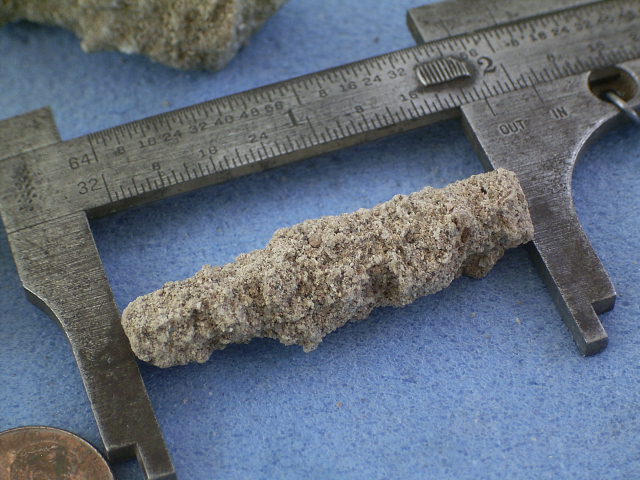
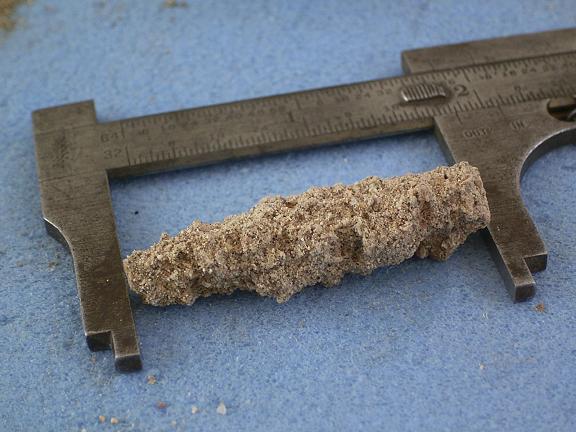
Standard caliche piece at lower right. Each tip-dipped. |
parent piece of small caliche piece is in back,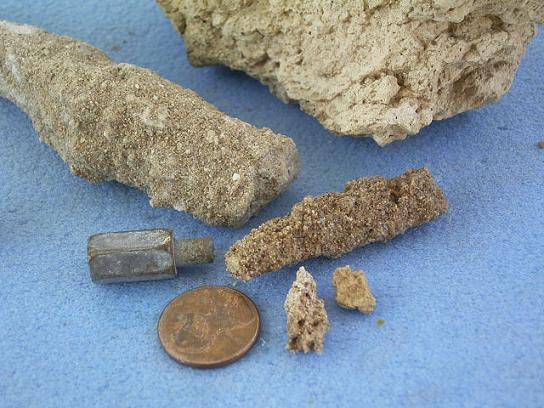 |
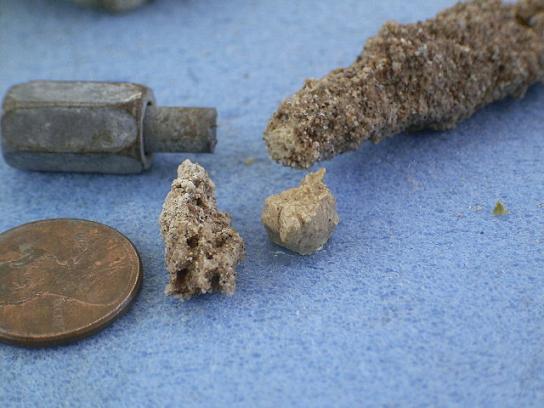
The small caliche piece in the foreground was broken off the larger one and then dipped i acid for a minute.
Figure 8 aspect may point to current path
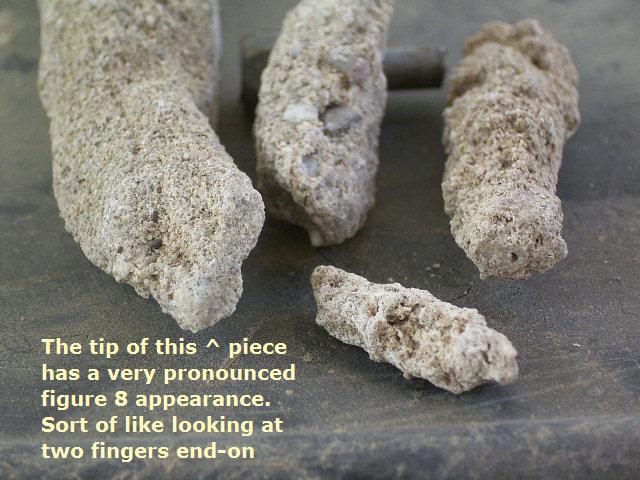
Current can flow most efficiently by forming two adjacent aspects in filamentry form that rotate around a common axis.
Search Birkeland current at www.holoscience.com
Before and After acid dip of tip
As mysteries go i'd rank this one right near the top.
http://www.spiritrockshop.com/Sand_Spikes.html
They Start the article saying no discussion of concretions would be complete without mention of Sand Spikes (i never new). The location of these is mperial county california near Yuma, Az. and the majority found are said to be facing west. Those shown in their image are very close to the appearance of my sample,, only theirs are complete and a must see. They do say that: "It has also been suggested that they are some type of fulgurites, which is positively incorrect." Their reasoning seems to be the way that they are found,,, but if you look at the images of one group and consider their first observation, westerly orientation, and the appearacne of the surroundng material,, I think there is a bigger mystery here. "Where did they come from?" these don't look to have formed there! With them laying on their sides and facing the same direction, i'd gamble on one of two possibilities for their orientation.
1. Long distance transport option would suggest that these were carried from their point of origin to here in the massive amounts of water that emptied out through that area. Their explanation seems to overlook where this location sits, right in the heart of Grand flood-ville, as in Canyon. So being carried there is not a hard stretch.. But has the problem of damage in transport..
2. The other option i'd describe as wave rolled or gravity rolled or both. Their observation that these were very brittle when first found and only hardened once they dried provides the clue of brief involvement with moistened material, possibly the tidal movement of that water in and out of a tributary with them laying along the bank being moved back and forth collecting material with their movement.
If you are not equipped with 3D viewing capability, i've got inexpensive side-by-side viewers or you can get them on line, read more at this link.